


I Never Took MBTI Seriously Until AI Made It Useful
Not as a classification system — as a way to make AI actually understand how I think.
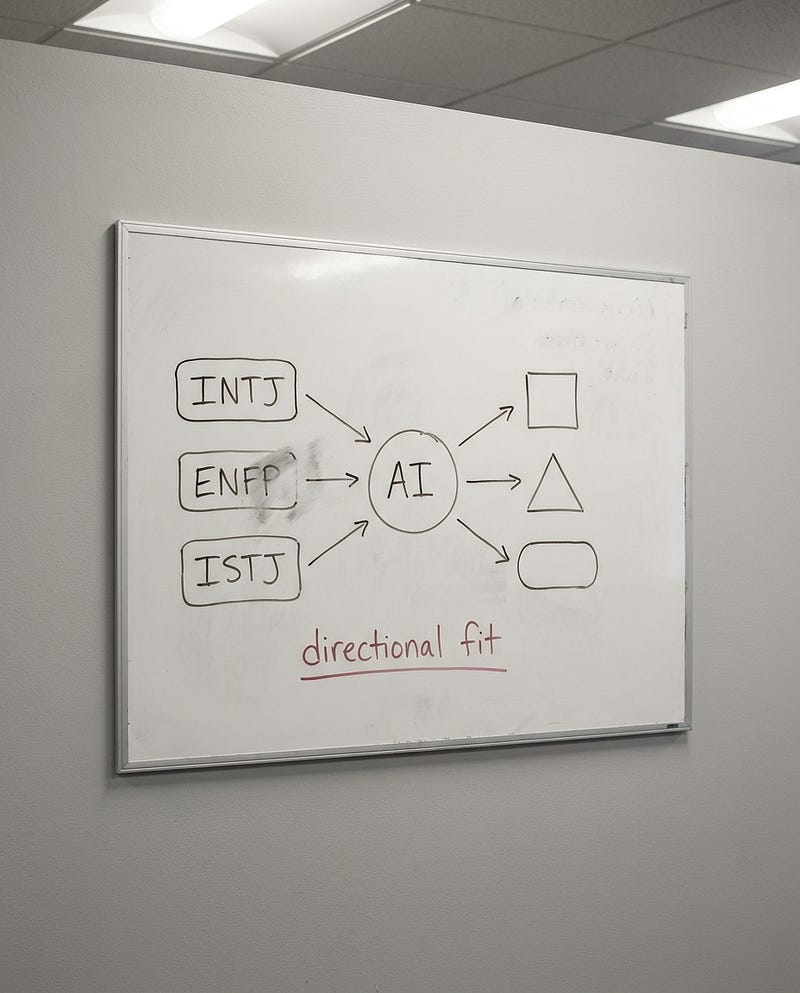
I didn’t treat MBTI with much seriousness. It tries to measure people by four criteria, and each criterion is a spectrum that can shift over a lifetime. With age and without major changes, most people’s values settle, so there is something relatively stable to measure — but the measurement is still coarse. All people are unique, and a four-letter type only partially applies. I knew my type. I didn’t build on it.
AI changed that. Not because AI validated MBTI as science, but because MBTI turned out to be the most popular personality terminology in the training data. LLMs know it well. They can operate fluently with all sixteen types and their cognitive functions — what each type notices first, what it filters out, how it sequences information, what kind of explanation clicks and what kind doesn’t.
Each type genuinely does consume information differently. What is immediately clear to one type is opaque to another. The same explanation restructured for a different cognitive sequence lands completely differently. I can ask AI to estimate someone’s MBTI type — from their messages, their writing style, their decision patterns — and then tailor a message to be understandable for how they actually think.
For personal communication there is no point wasting tokens on this. For business — a proposal, a difficult conversation, a message to someone whose thinking I find hard to predict — it can be worth the effort.
AI is not accurate at typing people from a single pass. It misses context, misinterprets signals. But across several parallel sessions with different framing, it can approximate a type with reasonable precision. And total precision is not the goal anyway. Types are a spectrum, close types consume information similarly. An INTJ-tailored message will land almost as well with an ISTJ. The tailoring needs to be directionally correct, not surgical.
The more interesting application is for myself. When I struggle to understand something — a new concept, a framework, a programming language — I ask AI to explain it taking into account how I actually think. Not for a generic reader. For my specific mindset. The difference is noticeable. Information becomes more accessible when it arrives in a structure that fits my cognition rather than a one-size-fits-all explanation.
This is not free, though. You need multiple agents, iterations, verification — the same orchestration and gates you need for any serious AI-assisted work. It consumes tokens. For idle curiosity you would not bother. But for learning something you actually need quickly, the cost might be worth the compression in time.
And there is a third angle, one that gets discussed often but rarely solved cleanly. AI-generated messages are nauseous to read. I genuinely started feeling sick seeing clearly AI-written text in social media posts and work correspondence — the same flat cadence, the over-polished vocabulary, the slop. One approach is to feed AI enough of your own writing so it imitates your patterns. That works, but it converges — every new message starts sounding like a remix of old ones.
A different approach: add a subagent in the chain that does not imitate your past text but ensures the output is consistent with your MBTI type’s communication patterns. The type defines how the text should think, not what it should say. New content comes out reading like you without being a copy of something you wrote before.
As personality science, MBTI remains what it always was — coarse and partially applicable. But as an instruction layer for AI — for tailoring messages to other minds, for making explanations fit my own cognition, for constraining AI output toward my voice without copying my old text — it is more useful than I expected.
I do not know if anyone has already productised this. It seems like an obvious enough intersection that someone should have by now.